Staff guide · 2026 edition
How to Spot a Fake ID: A Step-by-Step Guide for ID Checkers
Ten simple checks, ten seconds at the door. Learn exactly what to look for, feel for and ask, so you never get caught out by a fake again.
Introduction
Why you need to know how to spot a fake ID
Knowing how to spot a fake ID is one of the most useful skills anyone working a door or a till can have. It protects your licence, your job and, most importantly, young people who shouldn't be drinking yet.
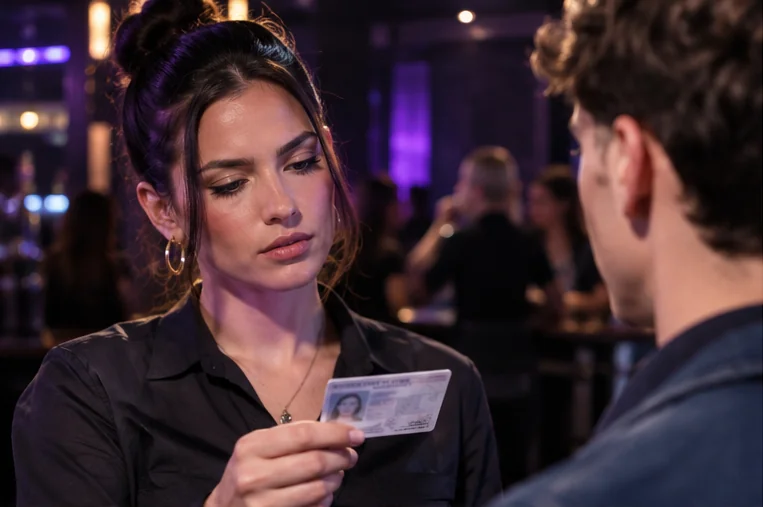
Picture a busy Friday night. The queue stretches down the street, and a confident teenager hands you a card that looks almost perfect. You have a few seconds to decide. That's exactly when a simple routine saves you.
Today's fakes look far better than they did ten years ago. Cheap printers, online sellers and borrowed cards make the job harder. However, almost every fake still fails at least one basic check, and this guide shows you all of them.
What happens if you get it wrong
Serving someone underage can hit you and your business hard:
Regulators can fine you, fine the business, and suspend or revoke your alcohol or tobacco licence.
A suspension means lost trading days, and an injured underage customer can lead to a lawsuit.
One failed test purchase or news story can undo years of goodwill.
The good news? You don't need to be an expert. You just need to follow the same ten steps every time.
Preparation
Before you start: set up your ID checkpoint
Good ID checks start before the doors open. Keep these tools within reach at every entrance and till:
| Tool | What it helps you do |
|---|---|
| Bright, even lighting | See photos, fonts and laminate flaws clearly |
| Small flashlight | Shine light through the card (the backlight test) |
| UV (black) light | Reveal hidden ink and images on modern IDs |
| Magnifier (5x–10x) | Read microprinting and fine lines |
| ID scanner or app | Compare the barcode or chip data with the printed details |
| ID reference guide | Check the current design of local and foreign IDs |
| Genuine sample cards | Compare feel, thickness and colours side by side |
| Refusal log | Record every refused or confiscated ID |
Next, agree on the ground rules with your team before each shift:
- Know your age limit. It's 21 for alcohol and tobacco in the U.S., and 18 in the UK and most of Europe.
- Set a "looks under" rule. Many UK shops use Challenge 25, so staff ask anyone who looks under 25 for ID. Some venues simply check everyone.
- Decide which IDs you accept. Usually that means a driving licence, national ID card, passport or official proof-of-age card. Settle in advance how you handle foreign IDs, paper licences and digital IDs.
- Name a go-to manager. Every checker should know exactly who to call when something feels off.
The routine
How to spot a fake ID in 10 simple steps
Run through these steps in the same order every time. A fixed routine stops you skipping checks, and it stops a smooth talker from rushing you.
Take the ID in your hand
First, ask the customer to take the card out of their wallet, phone case or sleeve and hand it to you. Never check an ID while they're still holding it.
Why does this matter? Sleeves hide peeling edges and bent corners. On top of that, you can't do the feel, light or scan tests on a card you're not holding. Also watch how they hand it over. Long fumbling, or offering a different card first, is worth a mental note.
Match the photo to the face
Look at the photo, then the face, then the photo again. Focus on features that don't change easily:
- the shape of the ears, nose and chin
- the distance between the eyes
- cheekbones and jawline
- the height and eye colour printed on the card
In contrast, ignore hair, glasses, beards and weight, because people change those all the time. If you're unsure, politely ask them to remove a hat or glasses. A mismatch usually means a borrowed or stolen real ID, and no scanner will ever catch that.
Check the date of birth yourself
Read the date of birth slowly and work out the age yourself. Don't just take the customer's word for it.
- Use the right date format. The U.S. writes MM/DD/YYYY, while the UK and most of Europe write DD/MM/YYYY. The wrong format for the issuer is a big red flag.
- Use a cut-off sign. Many venues post a daily sign saying "Born on or before [date]". That way, nobody does maths under pressure.
- Watch for vertical cards. Many U.S. states print portrait-style licences for under-21s. So if someone hands you a vertical card as proof they're over 21, look closer.
- Spot a changed year. Uneven spacing, a digit in a slightly different font, or a scratched area over the year all point to tampering.
Check the expiry and issue dates
Next, make sure the ID hasn't expired. Most venues refuse expired cards outright, since counterfeiters often copy older designs. Then check the issue date makes sense. For example, a licence issued before the holder turned 16, or after its own expiry date, is simply impossible.
Study the design closely
Now compare the card with your reference guide or a genuine card from the same issuer. Look for:
- Typos: real IDs are proofread, but fakes often misspell field labels, place names or official titles.
- Mixed fonts: every field should use one font, size and weight. Mixed fonts suggest someone edited the details.
- Wrong logos or seals: check the colours, design and position against the current version.
- Odd layout: the photo, signature and barcode should sit exactly where the reference shows them.
- A poor photo: genuine photos are sharp and printed into the card. Blurry, pixelated or stuck-on photos suggest a homemade job.
- Outdated designs: issuers refresh their IDs every few years, so a brand-new card in an old design deserves a second look.
Use the feel test
Run your thumb over both sides, then bend the card gently. Your fingers often notice what your eyes miss.
| What you check | A real ID | A typical fake |
|---|---|---|
| Material | Tough polycarbonate or PVC | Thin plastic, card or laminated paper |
| Flex | Bends slightly, then springs back | Creases, cracks or feels stiff |
| Surface | Smooth, often with raised areas | Too glossy or completely flat |
| Thickness | Matches other real cards | Noticeably thinner or thicker |
| Edges | Clean and even | Rough, uneven or showing layers |
Above all, watch for peeling, bubbling or lifted laminate over the photo or date of birth. It's one of the clearest signs of tampering. The more real cards you handle, the faster you'll feel when something's wrong.
Use light to reveal hidden features
Most modern IDs hide security features that you can't see in normal light. Try these four quick checks:
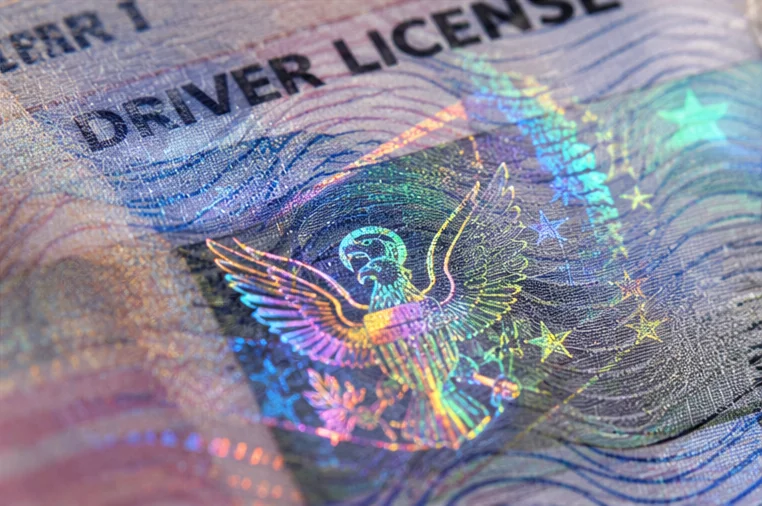
- Tilt it. Holograms and colour-shifting ink should change smoothly as you tilt the card. A flat, foil-like hologram, or one that sits on top like a sticker, is suspicious.
- Backlight it. Shine your flashlight through the card. Some IDs show a ghost image, whereas fakes may glow unevenly or reveal layers.
- Use UV light. Many IDs show hidden emblems, a repeated date of birth or a second photo under a black light. If those features are missing, or the whole card glows evenly, be wary.
- Magnify it. Real microprinting turns into tiny readable words. On fakes, it usually looks like a dotted or blurry line.
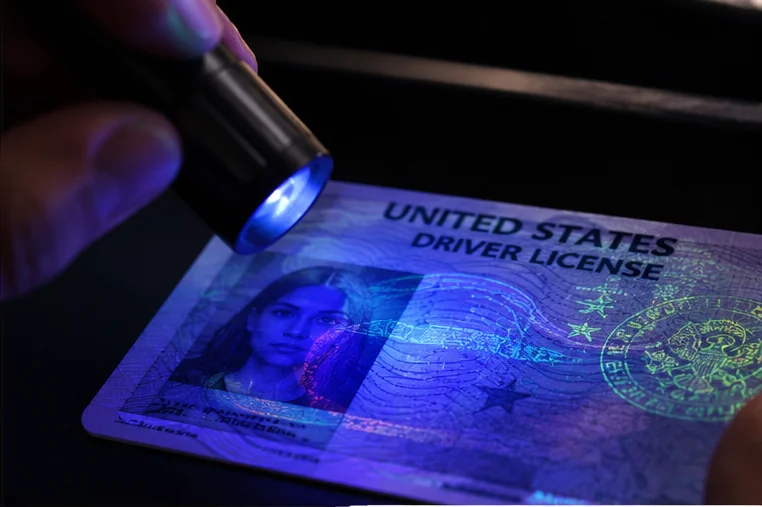
Keep in mind that features vary by issuer, so your reference guide tells you what each card should show.
Scan the barcode or chip
Most IDs store data in a machine-readable form. U.S. and Canadian licences carry a 2D barcode on the back, while passports and many European ID cards have a machine-readable zone or a chip. Scan it and check that:
- the scanned name, date of birth, expiry date and ID number match the printed ones
- the scanner doesn't flag an invalid format or unknown issuer
- the system calculates the age and expiry correctly
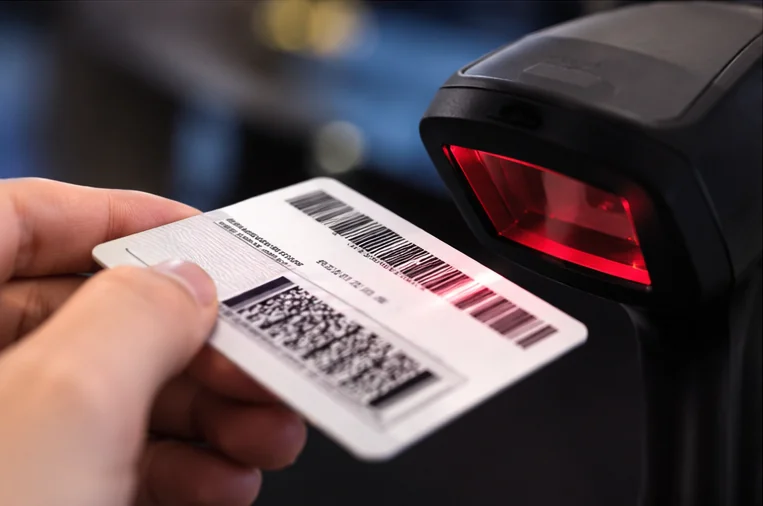
Don't treat a passed scan as proof. Some fakes carry correctly encoded barcodes, and no scanner can tell you whether the card belongs to the person in front of you. That's why you always combine scanning with Steps 2 to 7.
Look for signs of tampering
Some people alter a real ID instead of buying a fake one. These cards can pass several checks, so look specifically for:
- scratches, erasure marks or raised areas over the date of birth or photo
- cut lines around the photo, or a photo sitting above the surface
- ink that doesn't match the print around it
- a second layer of laminate, or laminate that stops short of the edge
Have a quick chat
Finally, talk to the customer. A friendly question often exposes a borrowed or fake ID faster than any gadget. Ask things the real owner would answer instantly:
- "What's your star sign?"
- "What's your postcode?" or "What street is that on?"
- "Can you spell your middle name for me?"
- "Have you got a bank card with your name on it?"
Then watch the reaction. Hesitation, counting on fingers, avoiding eye contact or friends answering for them are all warning signs. Of course, lots of people get nervous at a door. Nerves alone prove nothing, but nerves plus a physical red flag tell you plenty.
For bars, venues & retail
Run steps 3, 4 and 8 in under two seconds
Sentinel ID+ reads the barcode, checks age and expiry, and shows staff a clear green, amber or red result.
Know the tactics
Common fake ID tricks (and how to beat them)
Most problem IDs fall into five groups. Each one fails a different step, which is exactly why you shouldn't skip any of them.
| The trick | What you'll see | Caught by | What you do |
|---|---|---|---|
| Counterfeit card | A completely fake card made to look real | Steps 5–8 | Refuse and follow your confiscation policy |
| Borrowed or stolen ID | A real card that belongs to a sibling, friend or stranger | Steps 2 and 10 | Refuse, or ask for a second ID |
| Altered real ID | A genuine card with a changed date of birth or photo | Steps 3 and 9 | Refuse, as the card is usually evidence of an offence |
| Unfamiliar foreign ID | A card from a country or state you rarely see | Step 5 with your guide, plus Step 8 | Ask for a passport, or refuse if you can't verify it |
| Expired or replaced ID | An old card, or one reported lost and reissued | Steps 4 and 8 | Refuse expired cards and check for the latest issue |
Watch out for two more situations, too:
- Groups: when you turn one person away, their friends may pass the same card back or hand you lookalike IDs. So check every card in the group on its own.
- Paper and digital IDs: some places issue temporary paper licences or phone-based IDs. Check your local rules first, and ask for a second photo ID alongside any paper licence.
Many counterfeit cards are bought online from overseas sellers. To see how one of the best-known fake ID sites operates, read the real story behind IDGod.
Handling it
What to do when you spot a fake ID
Here's the golden rule: if in doubt, refuse. You don't have to prove an ID is fake. You only have to be unsure that it's real.
- Stay calm and friendly. Skip the accusations. A simple "Sorry, I can't accept this ID tonight" works best.
- Ask for a second ID. A passport or another photo ID often clears up a genuine doubt in seconds.
- Bring in your manager if the customer argues or things start to heat up.
- Follow your confiscation policy. Some places let you keep a suspected fake and hand it to the police, while others don't. Know your local law first, and never use force to hold on to a card.
- Keep the card away from the group. Don't pass it to a friend, and don't hand it back if your policy says to keep it.
- Log what happened. Write down the date, time, ID type, reason for refusal, your name and a short description of the person.
- Call the police if the customer turns aggressive, if the ID looks stolen, or if local rules require a report.
A well-kept refusal log does more than tidy up paperwork. It shows inspectors and your local licensing authority that your team checks IDs properly and turns people away.
Free checklist
Fake ID checklist: check any ID in 10 seconds
Print this out and stick it by every door and till. If you answer "no" to anything, slow down and look closer.
Your team
Train your team to spot fake IDs
Even the best scanner won't help if your staff feel unsure. Confident, well-trained people and a clear written policy make the real difference.
Training that actually sticks
- Train every new starter before their first shift, including part-timers and agency staff.
- Refresh everyone every 6 to 12 months, and whenever a local ID design changes.
- Make it hands-on. Let staff handle real sample cards and confiscated fakes, so they learn the feel as well as the facts.
- Practise refusals. Short role-plays help staff say no calmly when the pressure's on.
- Use official courses where they exist, such as responsible-server schemes run by licensing bodies or industry groups.
Write a clear ID policy
Put your rules in writing so everyone works the same way. Your policy should:
- state your age limit and your "looks under" rule
- list the IDs you accept and the ones you don't, such as photocopies or photos on a phone
- explain how staff refuse, confiscate (where allowed) and log IDs
- name who makes the final call, such as the duty manager or head of security
- make it zero tolerance, so if an ID looks questionable, nobody gets served, regulars and friends included
Back your team with the right tools
Pair manual checks with an ID scanner for the most reliable results. In addition, keep an up-to-date reference guide at every station, and review your refusal log regularly to spot repeat patterns.
Finally, put up clear signs such as "No ID, no entry" or "We operate Challenge 25". Signs set expectations, cut down arguments at the door and put off anyone thinking of trying their luck.
Questions
FAQs about spotting fake IDs
What's the quickest way to spot a fake ID?
Take the card in your hand, feel it, then tilt it under a light. Cheap materials, peeling laminate and flat or missing holograms give most fakes away within seconds.
Can an ID scanner catch every fake ID?
No. A scanner catches mismatched or badly encoded data, but some fakes carry correct barcodes. Plus, no scanner can tell whether the person is the real owner, so always pair scanning with a photo check and the feel test.
Can I refuse service if I'm not sure an ID is real?
In most places, yes. Businesses that sell age-restricted products can usually refuse service whenever they aren't satisfied a customer is old enough. Just check your local rules on how to handle refusals fairly.
Am I allowed to keep a fake ID?
That depends on where you work. Some places allow or require you to confiscate it and hand it to the police, while others don't. Follow your local law and your written policy.
What should I do with a foreign ID I don't recognise?
Check it against your reference guide and scan it if your system supports it. If you still can't verify it, ask for a passport, because passports follow an international standard and are easier to check.
How often should staff retrain?
At least once a year, and also whenever local ID designs change or a new type of fake starts turning up.
Wrapping up
Final thoughts on how to spot a fake ID
Learning how to spot a fake ID doesn't come down to one clever trick. Instead, it's a simple routine: take the card, match the face, check the dates, study the design, feel it, light it, scan it, look for tampering and have a quick chat.
Follow those ten steps every single time. Back them up with a scanner, a reference guide and a zero-tolerance policy. That way, you protect your business from fines and licence trouble, and you help keep young people safe.
This article is for general information only and isn't legal advice. Rules on age-restricted sales, accepted IDs and confiscation vary by country and region, so for advice on your situation, speak to a qualified lawyer or your local licensing authority.